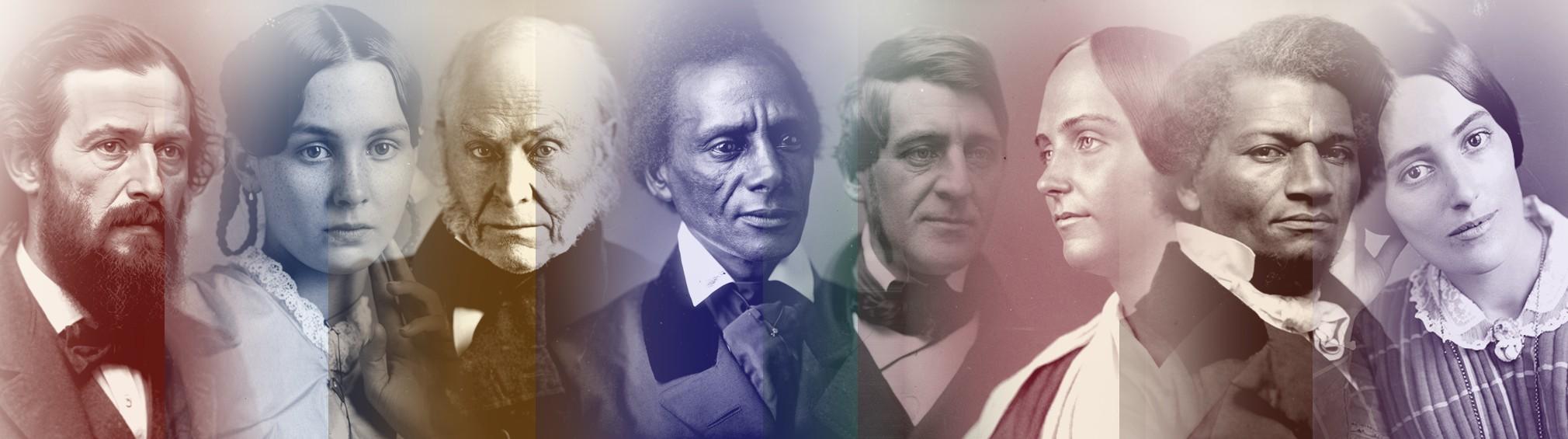
The Day — “A Great Open-Air Convention”
On August 2, 1844, more than six thousand people came together in Hingham, Massachusetts to celebrate the tenth anniversary of Great Britain freeing its slaves. Bells rang as delegations of abolitionists processed to a stand of oak trees called Tranquility Grove.
William Lloyd Garrison read a scathing letter from 77-year-old John Quincy Adams, who named the sitting U.S. president and his secretary of state a “knot of conspirators against human Freedom.” Frederick Douglass, still a fugitive six years after escape, anchored a lineup of at least a dozen speakers. In between addresses, the Hutchinson Family Singers — the movement’s most famous musicians — sang what a witness called their “exquisitely simple, sweet and soul-thrilling strains.” Tenor and violinist John Hutchinson wrote about the day 52 years later in his memoir, placing abolitionist lecture circuit stars Abby Kelley and Charles Lenox Remond at the event.
Celebrants passed a hat to collect defense funds for Charles Torrey, a Massachusetts minister jailed in Maryland for running a daring escape line with his formerly enslaved Black partner, Thomas Smallwood. A brass band played. The crowd sang hymns, lashed out at common enemies, and petitioned God.
At the same time, the movement was under intense strain.
- The Methodists, the largest church in the country, were breaking apart over a slave-owning bishop. The Baptists would soon follow.
- The Liberator, Garrison’s newspaper, was calling for free states to leave the Union. Speakers including the free-born Black lecturer Remond made the case against sharing a nation with slaveholders, while Congressman Adams fought to stay.
- Torrey, the jailed minister who was a hero to many in the movement, had also led the faction that tried to keep women — Abby Kelley among them — from voting at their own convention.
They fought among themselves constantly, even over who owned the day. While the overwhelmingly white organizers of abolitionist “picnics” like the one held in Hingham seized on the Emancipation Day anniversary as a recruiting opportunity, voices in the Black church — including Rev. Jehiel C. Beman of the AME Zion congregation in Boston — argued the celebration was theirs. The anti-slavery coalition was united by little beyond the shared moral imperative of ending slavery.
Events were unfolding rapidly and the movement’s internal conflicts would soon be overshadowed by the country’s descent into violence. Expansionist James K. Polk had been nominated in May, 1844. Texas annexation would follow the next year, and war with Mexico the year after. Within a decade, pro-slavery and free-state settlers would be fighting a guerrilla war in the Kansas Territory, armed by some of the same New England abolitionists who backed Harriet Tubman, Smallwood & Torrey, and John Brown. Harpers Ferry, the Civil War, emancipation, and Reconstruction’s collapse would define the next three decades.
The small group of radical thinkers, speakers, and singers who gathered at Tranquility Grove — and appeared together at dozens of anti-slavery events in 1843 and 1844 — would soon be fighting bitterly over one question:
Could slavery be ended without force?
That Night — A Memorable Fiasco
By sunset, the speeches and songs were over, and the food and drink were long gone. An organizing committee including John Quincy Adams’ cousins — Anna, Catherine, and Eliza Thaxter — had set up roped-off tables of prepared and donated plates and platters. They laid out boiled ham and beef tongue, cakes, pies, fruit, fresh vegetables, tea, coffee, and lemonade. There still wasn’t nearly enough for the huge crowd.
Hungry and tired from the heat, hundreds walked back to the wharf, then herded onto a steamboat meant to carry them across the harbor to Boston. Shortly after the steamer started, it stopped. The captain had timed the tide wrong and ran the boat aground in the flats, where it would stay until dawn.
A 23-year old Sarah Southwick, recording secretary of the Boston Female Anti-Slavery Society and friend of the prominent Weston sisters, was on board. In her 1893 memoir, she’d describe a scene of “over six hundred people, tired, sleepy, hungry, thirsty, cold, a good many children among them, with no food, water, beds, or bedding.”
John Hutchinson, also 23 in 1844, would write about the night in his own 1890s memoir. He tore a loose cabin door (“which seemed to be serving no very useful purpose”) off its hinges and placed blocks of wood under it to make a seat for himself and six other “weary ones.” As the night dragged on he tried lying under a table, until the feet of the people still sitting at it drove him out. Francis Jackson, the powerful Boston merchant and long-time president of the Massachusetts Anti-Slavery Society, slept on a pile of firewood. Robert Purvis, one of the wealthiest Black men in America and station keeper on the Philadelphia Underground Railroad, had his nose accidentally tugged by another marooned passenger fumbling in the dark.
In both accounts, a young group in their 20s and early 30s gave up trying to sleep and ran wild. Among them were Douglass and anarchist newspaperman Henry Clapp (who would go on to champion Walt Whitman and help launch Mark Twain’s career).
Jesse Hutchinson took the lead in an absurdist performance that likely roped in his younger sister Abby, and brothers Judson and Asa. Abolitionist conventions like the one held at the grove were run by resolutions. Jesse poked fun, roving the upper deck, pulling small groups of passengers into nonsensical Parliamentary votes. Jesse punctuated the bits with declarations: “Resolved, that we had our usual quiet night’s rest!” Then onto the next “meeting,” and another “verdict”: “Resolved, that we have had our breakfast!”
According to John, 38-year-old Garrison “viewed these performances with some disapproval, and quietly warned these young men against injuring their personal influence by too much levity.” John added that Garrison “could not forget that the party came to Hingham on serious business.”
By sunrise the tide came in and the steamboat chugged across the harbor. Southwick remembers their arrival: “A more bedraggled, forlorn crowd, I think, never went through the streets of Boston.”
John Hutchinson’s version puts a comforting (if not quite true) gloss on it: “[H]ard times and good times have an end, and at last we... ate our breakfasts, secured some sleep, and soon the impression of everything but the good time we had had passed off.”
Premise
Tranquility Grove | 1844 is built on a question: Where would that day live in the memories of an abolitionist looking back from the other side of the Civil War and Reconstruction?
Think of Asa Hutchinson, the Family Singers’ bass voice and cellist. He was a key figure in the movement and never publicly doubted his anti-slavery convictions, but would experience enough loss — political and personal — to understand the cost. How might a musician like Asa struggle to resolve his memories, inexact and conflicting as they’d be, into his later work and performances?
The family’s youngest son, Asa was 21 in August 1844. By the early 1880s, he was in his late-50s and living in Minnesota. His first wife was dead and his second marriage failed. It’s natural to imagine him facing a lonely winter at the edge of the vast prairie. If he did, he wouldn’t be the only alumnus of the pre-war anti-slavery movement questioning the value of his life’s work.
Manisha Sinha, author of The Slave’s Cause, writes of Asa’s contemporaries: “Abolitionists wrote their memoirs even as disfranchisement, segregation, debt peonage, and lynching made a mockery of black freedom... It made for narratives of defeat, not triumph. The tragedy of the Civil War was not that the abolitionist vision briefly triumphed over inertia and conservatism but that the opponents of the abolitionists, of their moral urgency and devotion to black rights, plunged the nation into yet another long racial nightmare.”
Asa didn’t publish a memoir but his life story is well-documented. Sitting in church as a young boy, he rocked his head against the pew rail to accompany the congregation’s vocals, generating a vibration his brother Joshua described as simulating the “sub-bass of a big organ.” The family’s fame grew and Asa struggled to balance the demands of art and commerce, writing in his diary, “we cannot be so free to sing high and lofty sentiments to an audience when we feel bound to sing to their Pockets instead of their hearts.” The Hutchinsons peaked as they toured with Douglass in the U.S. and Britain, then slowly came apart, one sibling at a time. Abby married a stockbroker in 1849, moved to New York City, and left the group. Jesse contracted “Panama fever” on his way home from California and died at the Cumminsville Water Cure in Ohio in 1853. Judson committed suicide in 1859, hanging himself in an unfinished basement in Lynn, Massachusetts.
Asa married — Lizzie, a whaling captain’s daughter from Nantucket — and kept making music. The couple formed their own family singers, “Tribe of Asa,” performing with their daughter and two sons. During the Civil War and Reconstruction, his family toured New England and the Upper Midwest, sometimes appearing with his older brother’s family group, “Tribe of John.”
He and Lizzie made a home in Minnesota’s Hassan River valley in Hutchinson, a town he and his brothers founded on equal rights for women. His sister described her visit to the farmhouse when it was full of life—
This morning I have been to walk with Asa’s two dogs...
The sun is about setting, the autumn wind blowing...
Cracked wheat, chickens, wild duck and goose, home-made bread, sweet butter and good cheese. Asa and Lizzy have done well here to get so much done; all they buy is sugar, tea and salt...
I am clearing out the brush from the woods near the house, and making paths through them...
Just while I write [my brother’s son] Fred is playing the cornet, [his daughter] Abby pianoforte, and Asa bass viol...
Music seems to belong to the Hutchinson family, wherever they may congregate...
In Asa’s 40s and 50s, the losses piled. His daughter Nellie died at five, his son Fred at twenty-two. Lizzie died suddenly the next year while they were on the road singing for the Minnesota Temperance Union. His daughter Abby lived with her husband in Hutchinson, but became too ill to sing. His brother John wrote that the loss of Abby’s voice had a particularly “depressing effect on Asa.”
Still, he continued to make music.
John visited Asa around this time and wrote that their two families held a birthday gathering in a grove by the river where “the citizens gathered en masse to hear us sing and play.” They held a praise meeting in the same grove three days later and a concert at the Methodist Episcopal Church they’d founded together during the same visit. Up until just a few weeks before his death in 1884, the Hutchinson Leader reported, Asa “was planning a visit to New Orleans, there to meet and sing to those freedmen for whom he labored so long.” At his funeral, according to the Glencoe Register, the cello “that had for so many thousand times responded to the delicate touch of the fingers” stood at the foot of his casket.
The eight poems that make up Tranquility Grove | 1844 are devised from the words Asa would have sung, heard, and read, and remembered — in fragments, as lyrics — as a man nearing the end of his life.
Source Texts
- Jesse Hutchinson, Jr.’s “Get Off the Track! A Song for Emancipation,” Boston: Published by the Author, 1844.PDF 2.4 MB
- Almira Seymour’s “Hymn for the 1st of August,” written for the August 2, 1844 West India Emancipation celebration at Tranquility Grove. Published in the Hingham Patriot, August 16, 1844.PDF 3.7 MB
- John Quincy Adams’s letter (Quincy, Massachusetts, July 29, 1844) to Anna Quincy Thaxter, read aloud by William Lloyd Garrison at the Tranquility Grove celebration on August 2, 1844.PDF 6.5 MB
- Charles Lenox Remond’s speech to the New England Anti-Slavery Convention, Marlboro’ Chapel, Boston, May 28–31, 1844. Published in the National Anti-Slavery Standard (New York), July 18, 1844.PDF 17.5 MB
- Ralph Waldo Emerson’s address “Emancipation in the British West Indies” (1844), first delivered in Concord, Massachusetts on August 1, 1844.PDF 2.4 MB
- Abby Kelley’s speech “What Has the North to Do With Slavery?” delivered in Little Falls, New York, 1843. Published in the Voice of Freedom (Brandon, Vermont), September 14, 1843.PDF 1.5 MB
- Frederick Douglass’ autobiographies Narrative of the Life of Frederick Douglass, an American Slave (1845), My Bondage and My Freedom (1855), and Life and Times of Frederick Douglass (1881).
- “Over the River” by Nancy Amelia Woodbury Priest, originally published in the Springfield Republican, 1857. Later set to music by Asa B. Hutchinson and published by Henry Tolman & Co. (Boston) in 1860; published posthumously by Lee and Shepard (Boston) in Over the River, and Other Poems (1883).PDF 3.6 MB
Secondary Sources
- Martha Reardon Bewick, Tranquility Grove: The Great Abolitionist Picnic of 1844. Hingham, Mass.: Hingham Historical Commission, 2018.Publisher
- Scott Gac, Singing for Freedom: The Hutchinson Family Singers and the Nineteenth-Century Culture of Reform. New Haven: Yale University Press, 2007.Yale
- Manisha Sinha, The Slave’s Cause: A History of Abolition. New Haven: Yale University Press, 2016.Yale
- John Wallace Hutchinson, Story of the Hutchinsons (Tribe of Jesse), 2 vols., ed. Charles E. Mann, intro. Frederick Douglass. Boston: Lee and Shepard, 1896.Vol. 1 for Hingham and the stranding; vol. 2 for Asa’s later life, and for the Hutchinson Leader and Glencoe Register notices of 1884, reprinted there.
- Sarah H. Southwick, Reminiscences of Early Anti-Slavery Days. Cambridge, Mass.: Riverside Press, 1893.Pp. 31–34, “First-of-August Picnic at Hingham.”Google Books
- The Liberator (Boston), vol. 14, nos. 22, 31, and 32: May 31, August 2, and August 9, 1844.
- Hingham Patriot, August 2, 9, and 16, 1844.